
Lightning Storm Safety Strategy: Risk Assessment, Strike Prevention, Forecasting Monitoring, and Emergency Response Planning
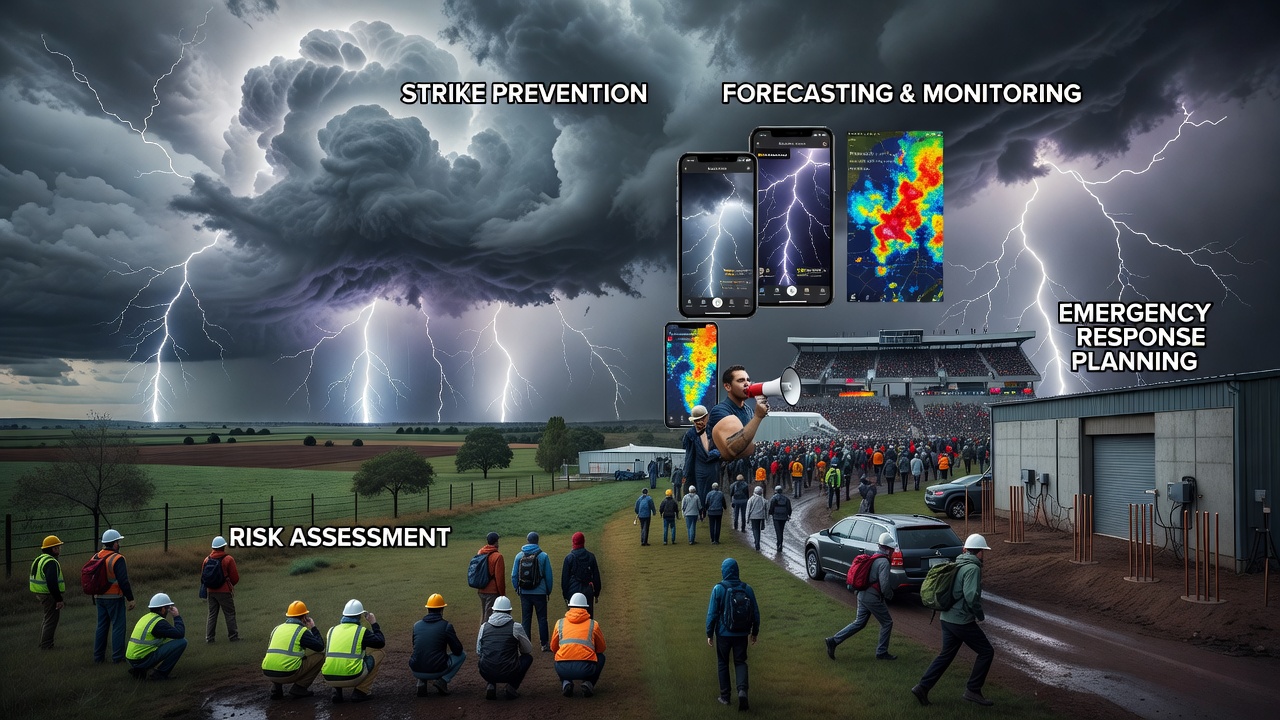
A single lightning bolt can carry up to a billion volts of electricity and reach temperatures five times hotter than the surface of the sun. Yet most people treat thunderstorms as background noise to daily life - something to wait out under a porch roof or a shade tree, both of which rank among the most dangerous places to be during a strike. The gap between how lightning actually behaves and how people respond to it explains why deaths and injuries persist even in regions with excellent weather infrastructure. Understanding that gap is the first step toward closing it.
This is where a coherent lightning storm safety strategy earns its value. It is not a single action but a layered system: knowing your exposure, reading the signs before a storm arrives, removing yourself from danger at the right moment, and having a plan for what happens if someone is struck anyway. Organizations that manage outdoor events, construction sites, or sports facilities increasingly treat this as a formal discipline rather than an afterthought, much the way some enthusiasts approach a lightning storm strategy in games of chance - calculating odds, timing decisions, and minimizing exposure to loss. The comparison is imperfect, but the discipline of preparation translates directly.
The sections that follow break this system into its working parts: how to assess your personal or organizational risk, how to prevent strikes through behavior and infrastructure, how to monitor and forecast storms before they become a threat, and how to build an emergency response plan that holds up when conditions turn severe.
Understanding Lightning Storm Risk: Why Preparation Matters
Lightning is not a random hazard confined to rare, dramatic events. It is a predictable atmospheric phenomenon tied to specific conditions - humidity, instability, and rapid vertical air movement - that recur every warm season across most inhabited regions. Treating it as an occasional inconvenience rather than a recurring hazard is the single biggest failure in how individuals and institutions approach storm safety.
How Lightning Forms and Why It's Dangerous
Thunderstorms generate electrical charge through the collision of ice crystals and water droplets inside towering cumulonimbus clouds. As charge separation builds, the ground beneath the storm develops an opposite charge, and when the electrical potential becomes great enough, a discharge - a lightning strike - bridges the gap. Strikes can travel miles from the parent storm cloud, which is why clear skies overhead offer no guarantee of safety.
Common Misconceptions About Lightning Safety
Many injuries stem from outdated or simply wrong assumptions. Rubber-soled shoes do not offer meaningful protection. Lying flat on the ground increases contact area and does not reduce risk. A car is safe not because of its rubber tires but because its metal frame conducts current around the occupants and into the ground. Correcting these misconceptions is a low-cost, high-impact part of any safety program.
Who Is Most Vulnerable
Outdoor workers, golfers, hikers, farmers, and anyone engaged in open-field recreation face disproportionate exposure. Groups gathered at stadiums, campgrounds, or construction sites carry additional risk because evacuation takes longer and communication is harder to coordinate. A sound thunderstorm risk assessment accounts for both the individual's exposure and the logistical difficulty of moving a group to safety.
Conducting a Thorough Thunderstorm Risk Assessment
Risk assessment turns abstract danger into a specific, actionable picture. It asks not just "will a storm occur" but "what happens to the people and assets under my responsibility if it does."
Identifying High-Risk Locations and Activities
Open fields, elevated terrain, bodies of water, and isolated structures all raise the odds of a direct or nearby strike. Activities that keep people outdoors for extended periods - agriculture, construction, outdoor sports, festivals - multiply exposure time and therefore risk. A useful assessment maps both the physical environment and the schedule of activity against seasonal storm patterns.
Evaluating Historical Strike Data for Your Region
Lightning frequency varies enormously by geography. Some regions experience dozens of thunderstorm days annually, others just a handful. Local meteorological services and aviation weather offices typically maintain historical strike density records that help quantify baseline risk for a specific site rather than relying on national averages that may not reflect local terrain or climate.
Assessing Vulnerability of People, Structures, and Equipment
Risk is not evenly distributed. Metal fencing, unshielded electrical equipment, and ungrounded structures raise the danger for anyone nearby. Elderly individuals, children, and people with limited mobility face greater difficulty reaching shelter quickly. A comprehensive assessment separates these vulnerabilities so mitigation efforts can be prioritized where they matter most.
- Open or elevated terrain with no nearby shelter
- Water-based activities such as boating, swimming, or fishing
- Sites with unshielded electrical or metal infrastructure
- Large gatherings with slow evacuation logistics
- Regions with high annual thunderstorm frequency
Lightning Strike Prevention: Practical Measures That Work
Prevention is where strategy becomes behavior. Knowing the risk means little without concrete steps taken before, during, and immediately after a storm approaches.
The 30-30 Rule and Safe Shelter Guidelines
A long-standing and reliable guideline instructs people to seek shelter if the time between seeing lightning and hearing thunder is thirty seconds or less, and to remain sheltered until thirty minutes after the last audible thunder. This rule works because it accounts for the fact that lightning can strike well ahead of the visible storm core, not just during the heaviest rain.
Grounding and Structural Protection for Buildings
Lightning strike prevention at the structural level relies on grounding rods, bonded metal framework, and surge protection systems that give a strike a controlled path to the earth rather than through a building's electrical or plumbing systems. Facilities in high-risk zones - communication towers, barns, warehouses with metal roofing - benefit from professionally installed lightning protection systems rather than ad hoc grounding.
Personal Safety Behaviors During a Storm
Individuals caught outdoors should avoid open fields, isolated tall trees, metal fences, and bodies of water. A hard-topped vehicle or a substantial enclosed building is the only genuinely safe refuge. Sheds, picnic shelters, and covered porches do not qualify, despite common assumption to the contrary.
Protecting Outdoor Equipment and Livestock
Farms and outdoor facilities face a different category of loss: livestock clustered under trees, irrigation equipment left connected, or unsecured metal machinery. Disconnecting non-essential electrical equipment and moving animals away from fence lines and isolated trees reduces both injury and property damage during active storms.
Storm Monitoring and Forecasting: Staying Ahead of the Threat
Prevention only works if you know a storm is coming with enough lead time to act. Storm monitoring and forecasting has advanced considerably, giving individuals and organizations tools that were unavailable even a decade ago.
Modern Weather Radar and Lightning Detection Networks
Doppler radar identifies the atmospheric conditions associated with developing thunderstorms, while dedicated lightning detection networks track individual strikes in real time using electromagnetic sensors spread across wide geographic areas. Together they allow forecasters to issue warnings based on actual storm behavior rather than general seasonal probability.
Mobile Apps and Real-Time Alert Systems
Smartphone applications now deliver lightning proximity alerts, often triggered the moment a strike is detected within a set radius of the user's location. For anyone managing outdoor events or work crews, these tools remove the guesswork from deciding when to pause activity, replacing subjective judgment with objective, location-specific data.
Interpreting Forecasts for Outdoor Events and Operations
Reading a forecast well means looking past the percentage chance of rain and toward the specific timing of instability and convective activity. Event planners and site managers should build in monitoring windows several hours ahead of scheduled outdoor activity, adjusting timelines proactively rather than reacting once a storm is already visible on the horizon.
Building an Emergency Response Plan for Lightning
Even the best forecasting cannot eliminate risk entirely. A written, rehearsed emergency response plan for lightning ensures that when a storm does arrive unexpectedly, the response is fast and coordinated rather than improvised.
Establishing Clear Evacuation Procedures
An effective plan designates specific, pre-identified shelters, defines who has authority to call an evacuation, and sets a maximum acceptable time for people to reach safety. Ambiguity about who makes the call is one of the most common failures in real-world incidents - precious minutes are lost while people wait for someone else to decide.
Communication Protocols During Active Storms
Reliable communication - public address systems, mass text alerts, or radio contact between staff - ensures that a warning reaches everyone, not just those near a single announcement point. Redundancy matters here: a plan that depends on one communication channel is a plan with a single point of failure.
First Aid Response for Lightning Strike Victims
Contrary to older beliefs, lightning strike victims do not carry residual electrical charge and are safe to touch immediately. Cardiac arrest is the leading cause of death from a strike, so immediate CPR and use of an automated external defibrillator, if available, significantly improve survival odds while emergency services are en route.
Post-Storm Recovery and Reporting
After the immediate danger passes, a complete response plan includes documenting the incident, inspecting structures and equipment for damage, and debriefing staff on what worked and what didn't. This feedback loop is what turns a static document into a plan that actually improves over time.
Frequently Asked Questions
How far away can lightning strike from a visible storm?
Lightning can strike as far as ten miles from the parent storm cloud, often well before rain begins falling at your location. This is why clear skies or light drizzle overhead should never be treated as a sign of safety.
Is it safe to shelter under a tree during a thunderstorm?
No. Isolated trees are among the most common strike points because they are often the tallest object in an open area, and a strike can travel through the trunk and roots to anyone standing nearby. Seek a hard-topped vehicle or substantial building instead.
Can lightning strike the same place twice?
Yes, and it frequently does. Tall structures such as towers, skyscrapers, and isolated trees can be struck repeatedly during a single storm or across many storms over years, which is exactly why grounding systems are installed on these structures.
What should I do if I'm caught outside with no shelter nearby?
Move away from open fields, water, and isolated tall objects, and crouch low with feet together and minimal ground contact, though this reduces rather than eliminates risk. Getting to a hard-topped vehicle or enclosed building as quickly as possible remains the only reliable safety measure.
How long should outdoor activities pause after lightning is spotted?
Wait at least thirty minutes after the last observed lightning flash or thunderclap before resuming outdoor activity. Storms often produce dangerous strikes on their trailing edge, well after the heaviest rain has passed.
Do lightning rods attract more strikes to a building?
No. A properly installed lightning rod does not increase the likelihood of a strike; it simply provides a controlled path for the electrical current if a strike does occur, protecting the structure and its occupants from fire and electrical damage.